Articles Posted in archived

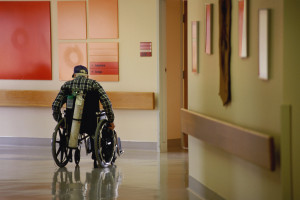
ECA_006Many nursing home residents are unable to protect themselves in the event of an emergency. As such, it is crucial that nursing home owners and staff prepare by implementing proper fire detection and protection measures as well as a detailed emergency evacuation training program.

The National Fire Protection Association (NFPA) has released nursing home fire safety tips for families and staff to plan and prepare for an emergency:

NFPA Message to Families: Are Your Loved Ones Safe?

Having a loved one in a nursing home can be stressful and can often make people feel somewhat helpless. Worries can intensify when you hear of the tragic nursing home fire that occurred in Hartford, Connecticut. You can play a role to increase the safety of your loved one. Here are a few things to consider when either choosing or checking on someone already in a nursing home.

  1. Is the building well maintained? Make sure that paper and other storage items do not block doors or hallways needed for escape.
  2. Check to make sure there is an evacuation plan in place that involves all staff and is practiced regularly.
  3. Are there safety systems in place such as alternative exits, smoke detectors, and sprinklers?
  4. Check on the staff-to-patient ratio. How many staff per resident during the day and especially at night or on weekends and holidays? Is supervisory staff available to carryout an escape plan if there is a fire?
  5. Are there guidelines for people who smoke such as a separate room or staff supervision?
  6. Does nursing home management take your questions regarding safety seriously and are they forthcoming with information?

You have a right to get answers regarding the safety conditions that effect your loved one. Make sure you take the time to ask.

NFPA Message to Nursing Home Staff: Planning and Practicing Fire Safety

Most people think the danger from fire is the flames, however, it is the smoke that can travel quickly to areas far from the fire. It is important to realize that people living in nursing homes may not be able to evacuate because of mobility or other disabilities. Proper planning, training, and practice of all staff are essential in order to provide for the safety of residents. It is important for staff to know that patient safety is their number one priority.

Adequate planning

  • Every facility should have written fire procedures that are understood and practiced by all staff. Staff should be responsible for knowing and carrying out their part of the plan. That includes doctors, nursing staff, kitchen staff, maintenance, volunteers, and others.
  • Response procedures should be practiced regularly
  • There should be a clear “code word” agreed upon beforehand for the facility to alert other staff in case of fire.

Quick response

  • Call out the code to alert staff.
  • Activate the fire alarm.
  • Evacuate everyone in immediate danger.
  • Close doors to contain smoke and fire.
  • Once the fire is contained to the room of origin behind closed doors, never reopen the door or reenter the room to extinguish the fire.
  • Close all doors to patient rooms.
  • In evacuating, make sure no patient is left behind.

Elderly Rights

Advocates for elderly rights and nursing home negligence attorneys at The Murray Law Firm encourage nursing home owners to implement comprehensive fire preparedness programs and training, according to NFPA codes. By implementing fire detection and protection safety measures, training nursing home staff to recognize and report fire hazards, and frequently practicing evacuation procedures, many fire-related injuries and fatalities may be prevented.

By law, property owners and managers are required to protect residents legally on the premises from any foreseeable harm. This responsibility is paramount when overseeing the health and care of elderly and/or disabled residents who may not be able to care for themselves. Should a nursing home owner or manager fail in this duty, the victim and their family may elect to hold the facility civilly liable for any injuries or wrongful deaths, which occur as a consequence.

We’ve Recovered Millions for Victims of Property Negligence…Contact us Now for a Free Consultation.
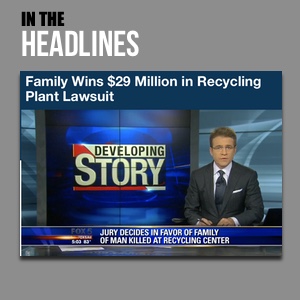
Headline Frame 11Alive DeskThe Murray Law Firm has an extensive and successful record representing victims of property negligence. We have recovered millions of dollars for our Clients, and recently obtained a $29.25 million dollar verdict for a victim of an unsafe property. We offer our legal assistance, if desired.

We represent our Clients on a contingency agreement, which generally means that no fees or payments are owed until and unless we recover.  Anyone seeking further information or legal representation is encouraged to contact us via e-mail (click here) or by telephone at 888.842.1616. Consultations are free and confidential.

728x90 Justice


Choosing the Right Attorney

Selecting the right attorney for you or your family is highly important. You must feel confident that the attorney you hire has a complete understanding of the law applicable to your particular case, and has successful experience in handling such cases.

Important: Do not hire a lawyer who has violated the Rules of Professional Conduct!!!

You should not hire an attorney who calls you or visits you unsolicited, or anyone that contacts you directly to offer legal services. This activity is strictly prohibited by Rule 7.3 of the American Bar Association (ABA) Model Rules of Professional Conduct, which states as follows:
ABA Center for Professional ResponsibilityA LAWYER “SHALL NOT” CONTACT A PROSPECTIVE CLIENT THROUGH A “LIVE TELEPHONE” OR AN “IN-PERSON” VISIT.

– RULE 7.3, ABA MODEL RULES OF PROFESSIONAL CONDUCT.

If an attorney, or someone acting on behalf of an attorney, contacts you in this manner, that attorney is in violation of this Rule. This unethical and unprofessional activity on the part of the lawyer is good sign that you should stay away. It is imperative that you are represented by an attorney who is capable of advocating for you within the confines of the law, and an attorney who fails to abide by the Rules of Professional Conduct is probably not the best fit. In fact, any such attorney should be immediately reported to the local State Bar Association. If you have been contacted in such an unsolicited manner, contact us and we’ll assist you in filing a report.

Contingency Fees Disclaimer: “Contingent attorneys’ fees refers only to those fees charged by attorneys for their legal services. Such fees are not permitted in all types of cases. Court costs and other additional expenses of legal action usually must be paid by the client.

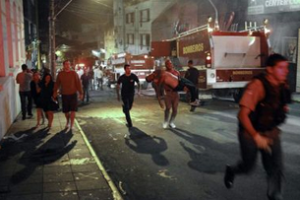
Fatal Kiss Nightclub Fire, Santa Maria, Brazil (NFPA)

240 People Killed in 2013 Nightclub Fire (NFPA)

The National Fire Protection Association (NFPA) warns, “Fires in assembly occupancies have shown to be some of the most deadly when the proper features, systems and construction materials were not present. Nightclubs, theaters and auditoriums differ from office buildings because they contain a large number of people in one main space. NFPA code provisions mandate that a considerable number of safety systems and features be present in order to keep everyone safe should an unwanted fire occur. The level of safety provided is not the result of any single safety system or feature, but rather is achieved through the combination of multiple safeguards that are provided.”

New Fire Code Recommendations

In 2003, following a deadly nightclub fire in Rhode Island and a fatal nightclub crowd-crush in Chicago, the NFPA and other fire safety community organizations met to implement emergency changes to fire safety codes in nightclubs and other assembly occupancies. Changes include:

  • Fire sprinklers in new nightclubs and similar assembly occupancies and in existing facilities that accommodate more than 100
  • Building owners to inspect exits to ensure they’re free of obstructions and to maintain records of each inspection
  • The presence of at least one trained crowd manager for all gatherings, except religious services. For larger gatherings, additional crowd managers are required at a ratio of 1:250
  • Prohibit festival seating for crowds of more than 250 unless a life-safety evaluation approved by the authority having jurisdiction has been performed. Festival seating, according to NFPA 101®, is a form of audience/spectator accommodation in which no seating, other than a floor or ground surface, is provided for the audience to gather and observe a performance

NFPA Nightclub Safety Tips

Before you enter:

  • Take a good look. Does the building appear to be in a condition that makes you feel comfortable? Is the main entrance wide and does it open outward to allow easy exit? Is the outside area clear of materials stored against the building or blocking exits?
  • Have a communication plan
    Identify a relative or friend to contact in case of emergency and you are separated from family or friends.
  • Plan a meeting place
    Pick a meeting place outside to meet family or friends with whom you are attending the function. If there is an emergency, be sure to meet them there.

When you enter:

  • Locate exits immediately
    When you enter a building you should look for all available exits. Some exits may be in front and some in back of you. Be prepared to use your closest exit. You may not be able to use the main exit.
  • Check for clear exit paths
    Make sure aisles are wide enough and not obstructed by chairs or furniture. Check to make sure your exit door is not blocked or chained. If there are not at least two exits or exit paths are blocked, report the violation to management and leave the building if it is not immediately addressed. Call the local fire marshal to register a complaint.
  • Do you feel safe?
    Does the building appear to be overcrowded? Are there fire sources such as candles burning, cigarettes or cigars burning, pyrotechnics, or other heat sources that may make you feel unsafe? Are there safety systems in place such as alternative exits, sprinklers, and smoke alarms? Ask the management for clarification on your concerns. If you do not feel safe in the building, leave immediately.

During an emergency:

  • React immediately
    If an alarm sounds, you see smoke or fire, or other unusual disturbance immediately exit the building in an orderly fashion.
  • Get out, stay out!
    Once you have escaped, stay out. Under no circumstances should you ever go back into a burning building. Let trained firefighters conduct rescue operations. (Source: NFPA)

We’ve Recovered Millions for Victims of Nightclub Security and Safety Negligence…Contact us Now for a Free Consultation.

Headline Frame Fox News FireThe Murray Law Firm has an extensive and successful record representing victims of nightclub security and safety negligence. We have recovered millions of dollars for our Clients, and we recently obtained a $29.25 million dollar verdict for a victim of an unsafe property. We offer our legal assistance, if desired.
We represent our Clients on a contingency agreement, which generally means that no fees or payments are owed until and unless we recover.  Anyone seeking further information or legal representation is encouraged to contact us via e-mail (click here) or by telephone at 888.842.1616. Consultations are free and confidential.

728x90 Justice


Choosing the Right Attorney

Selecting the right attorney for you or your family is highly important. You must feel confident that the attorney you hire has a complete understanding of the law applicable to your particular case, and has successful experience in handling such cases.

Important: Do not hire a lawyer who has violated the Rules of Professional Conduct!!!

You should not hire an attorney who calls you or visits you unsolicited, or anyone that contacts you directly to offer legal services. This activity is strictly prohibited by Rule 7.3 of the American Bar Association (ABA) Model Rules of Professional Conduct, which states as follows:

ABA Center for Professional ResponsibilityA LAWYER “SHALL NOT” CONTACT A PROSPECTIVE CLIENT THROUGH A “LIVE TELEPHONE” OR AN “IN-PERSON” VISIT.

– RULE 7.3, ABA MODEL RULES OF PROFESSIONAL CONDUCT.

If an attorney, or someone acting on behalf of an attorney, contacts you in this manner, that attorney is in violation of this Rule. This unethical and unprofessional activity on the part of the lawyer is good sign that you should stay away. It is imperative that you are represented by an attorney who is capable of advocating for you within the confines of the law, and an attorney who fails to abide by the Rules of Professional Conduct is probably not the best fit. In fact, any such attorney should be immediately reported to the local State Bar Association. If you have been contacted in such an unsolicited manner, contact us and we’ll assist you in filing a report.

Contingency Fees Disclaimer: “Contingent attorneys’ fees refers only to those fees charged by attorneys for their legal services. Such fees are not permitted in all types of cases. Court costs and other additional expenses of legal action usually must be paid by the client.

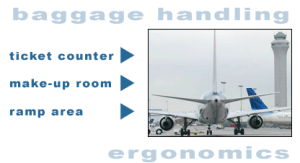
OSHA Baggage Handling Employee eTool

OSHA eTool for Airline Employees

Airline employees, including ticket agents and ramp agents, handle passenger baggage at several points throughout the baggage handling process. The body postures, repetitions, and forces required to lift, lower, push, pull, or carry passenger baggage can create potentially serious ergonomic hazards for the agents. The U.S. Occupational Safety and Health Administration (OSHA) warns, “many airline workers may be unaware of the potential hazards in their work environment, which makes them more vulnerable to injury.”

OSHA has developed an eTool as part of the OSHA-Airlines Industry and National Safety Council’s International Air Transport Section Alliance. This eTool describes many of the common hazards associated with the baggage handling process as well as providing possible solutions that are ranked according to their feasibility to the operations. Some hazards and solutions have been highlighted below:

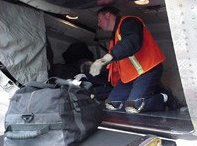
Baggage Handling Hazards

(OSHA)

(OSHA)

  • Handling heavy, large, or oddly shaped baggage requires use of excessive force and awkward postures, increasing the risk of musculoskeletal injury.
  • Handling uneven loads, such as when grabbing two bags of different weights or carrying a single bag with one hand, can lead to uneven muscle exertions and poor postures, making muscles, ligaments, and discs more prone to injury.
  • Repeatedly handling baggage can increase the risk of musculoskeletal injuries. 
    • Frequent lifting may not allow sufficient recovery time and increase the risk of muscle fatigue
  • Lifting a bag by the handle can result in awkward postures and may cause injury if handles break. (Figure 1)
  • Baggage straps getting snagged or caught on a beltloader may cause injury.
  • Falling baggage can cause injury to unsuspecting workers as well as those who try to stop or catch the falling bags.
  • Performing extended reaches while working in limited spaces can stress the neck and shoulders.
  • Reaching to push the container onto the loader can strain the back, shoulders, and arms.
  • Taking strollers, wheelchairs, or other oddly shaped and heavy items up or down loading bridge stairs can be dangerous, especially during wet or icy conditions
  • Twisting the torso while transferring baggage to the main conveyor, often several feet behind the counter.

Possible Solutions

  • Educate agents about proper lifting techniques to increase awareness of good work practices.
  • Perform stretching exercises that help loosen and relax the muscles and joints.
  • Use heavy luggage tags to create awareness of actual bag weights. 
  • Park carts within three to five feet from the beltloaders to minimize carrying distances.
  • Use a hand truck or cart to move large and heavy bags over long distances.
  • Secure or remove baggage straps.
  • Ensure that ramp agents do not throw baggage or attempt to catch falling baggage.
    • Forces due to acceleration may be two to three times greater than the object’s weight.
  • Use kneepads to reduce contact trauma and abrasive injuries when kneeling on hard surfaces.
  • Allow mechanical assist devices, such as a sliding carpet, to bring baggage close to you.
  • Conduct preventive maintenance inspections on rollers so manual positioning of containers results in as little resistance as possible.
  • Use chutes, slides, or mechanical lifting devices.
  • Tag baggage while it is in the bagwell to avoid repeatedly lifting it to a temporary position on the floor and then lifting it again to the main conveyor. 
  • Tag excessively heavy baggage and get help from another person or use a lifting aid when handling baggage with heavy bag tags.

Worker Rights

Airline industry employees have a right to a safe workplace. The law requires employers to provide their employees with working conditions that are free of known dangers. The OSHA law also prohibits employers from retaliating against employees for exercising their rights under the law (including the right to raise a health and safety concern or report an injury). For more information see www.whistleblowers.gov or worker rights.

We Fight for Victims of Workplace Injuries…Contact us Now for a Free Consultation.

Headline Frame Fox News DeskThe Murray Law Firm has recovered millions of dollars for victims of unsafe workplaces, and recently obtained a $29.25 million dollar verdict for one of our Clients.

We represent our Clients on a contingency agreement, which generally means that no fees or payments are owed until and unless we recover. Anyone seeking further information or legal representation is encouraged to contact us via e-mail (click here) or by telephone at 888.842.1616. Consultations are free and confidential.


Choosing the Right Attorney

Selecting the right attorney for you or your family is highly important. You must feel confident that the attorney you hire has a complete understanding of the law applicable to your particular case, and has successful experience in handling such cases.

Important: Do not hire a lawyer who has violated the Rules of Professional Conduct!!!

You should not hire an attorney who calls you or visits you unsolicited, or anyone that contacts you directly to offer legal services. This activity is strictly prohibited by Rule 7.3 of the American Bar Association (ABA) Model Rules of Professional Conduct, which states as follows:

ABA Center for Professional ResponsibilityA LAWYER “SHALL NOT” CONTACT A PROSPECTIVE CLIENT THROUGH A “LIVE TELEPHONE” OR AN “IN-PERSON” VISIT.

– RULE 7.3, ABA MODEL RULES OF PROFESSIONAL CONDUCT.

If an attorney, or someone acting on behalf of an attorney, contacts you in this manner, that attorney is in violation of this Rule. This unethical and unprofessional activity on the part of the lawyer is good sign that you should stay away. It is imperative that you are represented by an attorney who is capable of advocating for you within the confines of the law, and an attorney who fails to abide by the Rules of Professional Conduct is probably not the best fit. In fact, any such attorney should be immediately reported to the local State Bar Association. If you have been contacted in such an unsolicited manner, contact us and we’ll assist you in filing a report.

728x90 Justice

Contingency Fees Disclaimer: “Contingent attorneys’ fees refers only to those fees charged by attorneys for their legal services. Such fees are not permitted in all types of cases. Court costs and other additional expenses of legal action usually must be paid by the client.